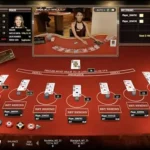
Live Blackjack for Beginners

Live blackjack for beginners starts with understanding the objective, learning the basic rules, and recognizing how each decision affects the game. This popular card game combines simple rules with strategic choices, making it accessible to newcomers while offering plenty of depth for experienced players. Live blackjack brings the experience to an online screen or physical casino table, where a real dealer manages the cards and communicates with participants.
However, beginners should understand that blackjack involves financial risk. No strategy guarantees a win, and short-term results can vary considerably. By learning the fundamentals before participating, newcomers can approach the game with realistic expectations and make more informed decisions.
What Is Live Blackjack?
Live blackjack is a casino card game in which players compete against the dealer rather than against other players. Online versions use video streaming to show a real dealer handling cards at a physical table. Players submit their decisions through an online interface, while the dealer follows the table’s established rules.
Unlike automated blackjack, live versions provide a more interactive atmosphere. Participants can watch the dealing process, follow the action, and communicate through a chat feature when available.
Nevertheless, the experience depends on the platform, connection quality, and specific table rules. Beginners should review these details before joining a game.
Understanding the Objective
The main goal is to achieve a hand value closer to 21 than the dealer without exceeding 21.
Card values work as follows:
- Number cards from 2 through 10 retain their printed values.
- Jacks, queens, and kings count as 10.
- Aces count as either 1 or 11, depending on which value benefits the hand without causing a bust.
For example, an ace and a seven can total either 8 or 18. Players generally use the ace’s value of 11 when it produces a stronger hand without exceeding 21.
A hand that exceeds 21 automatically busts, resulting in a loss unless the dealer has already settled the hand under a specific table rule.
How a Live Blackjack Round Works
Each round follows a predictable sequence, although some details vary between casinos.
Step 1: Place Your Bet
Before the dealer distributes cards, players select their wagers within the table’s minimum and maximum limits. Beginners should check these limits carefully and establish a fixed entertainment budget before playing.
Step 2: Receive Your Cards
The dealer typically gives each player two cards and deals two cards for the dealer, with one card often face down. The exact dealing procedure depends on the game variation.
Step 3: Choose Your Action
After reviewing their cards and the dealer’s visible card, players decide how to continue. The available actions usually include hitting, standing, doubling down, and splitting.
Step 4: Watch the Dealer Play
Once players finish their turns, the dealer reveals any hidden card and follows the house rules. Many tables require the dealer to hit until reaching at least 17, although rules for soft 17 differ.
Step 5: Settle the Round
The dealer compares eligible hands and determines the outcome. Players who beat the dealer without busting generally win their wagers. Equal totals usually result in a push, which returns the original bet.
A natural blackjack typically consists of an ace and a ten-value card dealt in the initial two cards. Its payout depends on the table rules.
Essential Blackjack Actions for Beginners
Understanding the main decisions helps new players follow the game confidently.
Hit or Stand
Hitting means requesting another card. Standing means keeping the current total. A player with a low total may need another card, while a stronger hand may benefit from standing, depending on the dealer’s visible card.
Double Down
Doubling down allows a player to increase the original wager, usually in exchange for receiving exactly one additional card. Tables may restrict when this action is available.
Split
When the first two cards have equal values under the table’s rules, a player may split them into two separate hands by placing an additional wager. Each hand then plays independently.
These actions involve different risks, so beginners should learn the table’s rules before using them.
Beginner Strategies for Better Decisions
Live blackjack for beginners becomes easier to understand when players learn basic strategy. Basic strategy uses mathematical probabilities to recommend actions based on the player’s hand and the dealer’s visible card.
For example, the correct decision for a hard 16 can differ depending on whether the dealer shows a low card or a strong ten-value card. The recommended move can also change when a hand contains an ace.
Consider these practical guidelines:
- Learn a basic strategy chart that matches the table’s rules.
- Check whether the dealer hits or stands on soft 17.
- Understand when doubling and splitting are permitted.
- Avoid making decisions based solely on previous rounds.
- Never assume that a losing streak makes a win more likely in the next hand.
Basic strategy can reduce the house edge under suitable rules, but it cannot eliminate the casino’s mathematical advantage.

Common Mistakes to Avoid
New players sometimes focus too heavily on winning quickly instead of learning the rules. This approach can lead to poor decisions and unnecessary losses.
Avoid these common mistakes:
- Increasing wagers to recover previous losses.
- Playing without checking the payout for a natural blackjack.
- Ignoring table limits and special rules.
- Assuming the dealer must bust after receiving a weak-looking card.
- Using money reserved for bills, savings, or essential expenses.
Additionally, remember that side bets often carry a higher house edge than the main game. Beginners should understand their terms before considering them.
Responsible Play and Final Thoughts
Live blackjack offers an engaging way to learn casino card-game mechanics, but it should remain entertainment rather than a source of income. Before participating, check the applicable laws in your location, choose a licensed provider where permitted, and set firm limits on both spending and playing time.
Ultimately, beginners benefit most from patience, rule awareness, and realistic expectations. Learn the card values, understand the available actions, and study basic strategy before risking money. Most importantly, recognize that every wager carries risk and that no system guarantees consistent profits.